
Two suppliers quote the same model at prices 30% apart. One of them is not necessarily cheating you — but one of them is quoting a different cable, or a different basis. Cable is one of the few industrial products where the price is almost entirely explained by three numbers: copper weight, sheath compound, and the standard the factory is actually testing to. This guide walks through the whole purchase, from the eight pieces of information that make a quotation usable, to how a container is loaded and which documents you should refuse to ship without.
Factory: Changyuan, Henan, China — inside the crane industrial park · Marketing center: Shanghai, China
Products: YC / YZW rubber cable, YVFB flat festoon cable, control, power and special cables
OEM / ODM: from 500 m — your brand, our manufacturing · Standards: IEC 60227 / 60245, GB/T
Every reply: price, lead time and the document list — within 24 working hours
What to send with your enquiry so the quotation is usable
Most first enquiries get answered with a price range, not a price. That is not evasion — it is because one of these eight items was missing. Send all eight and you get a number you can compare, plan around, and put in front of your own customer.
| Item | Why the supplier needs it | What happens if it is missing |
|---|---|---|
| Model or construction | Determines conductor stranding, insulation and sheath compound | Supplier quotes a generic cable of the right size but wrong duty |
| Core count and cross-section | Directly sets copper weight, which is most of the cost | Price is indicative only, usually padded to cover the uncertainty |
| Voltage class | Sets insulation thickness and the test regime | Quote may be based on the lower class — a real safety gap |
| Quantity and drum length | Sets up the production run and the packing plan | Price per metre is higher because the run is treated as small |
| Standard required | IEC, GB/T or a national standard changes the construction | Supplier assumes their domestic standard; may not be accepted at destination |
| Destination port and Incoterm | FOB and CIF are different numbers on the same cable | Comparing FOB against CIF makes every quote incomparable |
| Application and environment | Decides whether oil resistance, shielding or UV resistance is needed | Cheapest compliant cable is quoted, and it fails in service |
| Any certification needed at destination | Some markets require factory certification, not just a test report | Goods arrive and cannot be cleared or sold |
If you are still deciding which construction you need, describe the application instead — our guide to choosing cable by application covers cranes, port equipment, machine tools, building wiring and more.
How a cable price is actually built
Cable pricing is unusually transparent once you know the structure. Roughly 70–85% of the cost of a copper cable is the copper itself, priced off the metal exchange. The rest is insulation and sheath compound, the drawing and stranding work, packing, and margin.
You can estimate the copper content yourself with one formula:
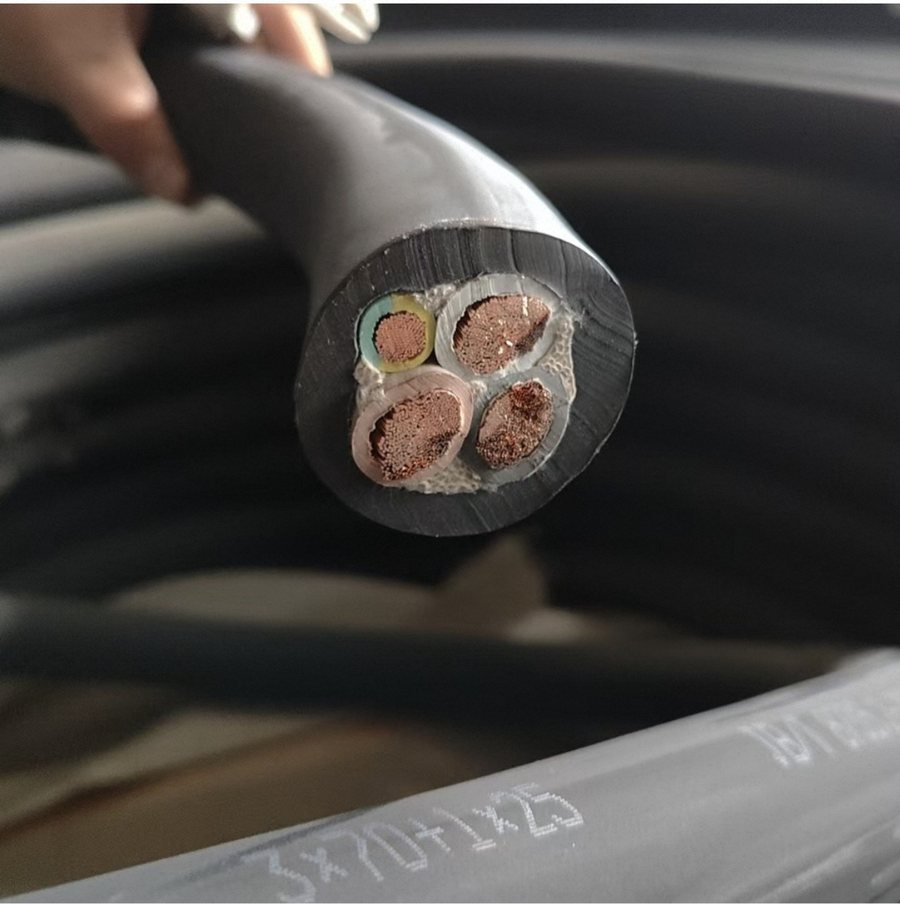
For a YC 3×6 mm² cable, the total cross-section is 18 mm², so the copper content is roughly 160 kg per kilometre. Add 2–4% for stranding and the permitted resistance tolerance. Multiply by the current copper price and you have the dominant cost line — before any sheath, labour or freight.
This is why the copper price moves your quotation. It is also why a quotation that is dramatically cheaper than the others usually means one of two things: less copper than the nominal cross-section, or a thinner and cheaper sheath compound.
Comparing two quotations on the same basis
Never compare total prices. Compare these five lines, one by one, and ask both suppliers to confirm each in writing:
1. Conductor cross-section and stranding. Nominal 6 mm² is not the same as actual 6 mm². Ask for the minimum cross-section and the maximum conductor resistance at 20 °C. A supplier who can quote both numbers is working to a standard; one who cannot is working to a price.
2. Sheath compound and thickness. “Rubber” covers a family of compounds. Ask for the sheath material designation and the average thickness. An oil-resistant compound costs more than a general-purpose one, and the difference shows up two years later.
3. Standard actually tested to. Not the standard printed on the quotation — the one the factory’s test report references. Ask for a sample test report before you order.
4. Packing and drum. Wooden drum or steel drum, drum length, and whether the drum is returnable. This is a real cost line and often hidden in the price difference.
5. Commercial basis. FOB or CIF, payment terms, and validity of the copper price. A quotation without a copper-price validity clause is not a firm price.
For a field-by-field walkthrough of the datasheet itself, see how to read a cable specification sheet.
Samples and pre-shipment inspection
A short sample length tells you three things that a datasheet cannot: how the sheath feels, whether the printing is legible and correctly positioned, and whether the conductor is genuinely fine-stranded. It does not tell you whether the production run will match — that is what inspection is for.
Before production: confirm the drawing or specification in writing, and ask for the pre-production sample to be sealed and referenced in the contract. Verbal agreement on “same as sample” is worth very little three weeks later.
Before shipment: for a first order, budget for inspection. You can send your own inspector, use a third-party agency, or ask the factory to provide a full set of photographs and test data before the container is sealed. Whichever route you choose, do it before the balance payment, not after.
What to check: measured conductor resistance, sheath thickness at several points, drum markings against the packing list, and a length check on at least one drum. These four catch most of the problems that matter.
Payment terms and where the risk sits
Standard practice for a first order from a Chinese cable factory is a deposit with the balance against the bill of lading copy — commonly 50/50, sometimes 30/70 for larger established accounts. The logic is straightforward: the deposit funds the copper, and the balance is released when you can see that the goods have actually shipped.
Documentary credit (L/C at sight) is available for larger orders and adds a layer of bank verification, at a cost. For a first order under roughly USD 30,000, the bank charges usually outweigh the protection a T/T structure already gives you, provided you inspect before paying the balance.
The part buyers underestimate: never release the balance against a photograph of a container being loaded. Release it against the bill of lading copy, which means the goods are on a named vessel with a named booking. That single detail removes most of the payment risk in a first transaction.
Packing and container loading
Cable is heavy and compact, so containers fill by weight long before they fill by volume. Plan around that:
| Container | Typical cable payload | What limits it |
|---|---|---|
| 20ft | around 18–20 tonnes | Weight, not volume — the container is only partly filled |
| 40ft | around 24–26 tonnes | Road weight limits at destination often bind before the container does |
Two practical notes. First, mixed orders load better than they look — a 20ft container can combine several sizes as long as the total weight works out. Second, ask for the drum dimensions and weights in advance: if a drum is too large for the receiver’s lifting equipment, the problem appears at the customer’s yard, not at yours.
Documents you should not ship without
Commercial invoice, packing list, and bill of lading are the baseline. Beyond those, three items decide whether the goods can actually be sold at destination:
Certificate of origin. Needed for preferential duty treatment under a trade agreement, and sometimes requested by the buyer’s bank.
Factory test report. Per batch, referencing the standard and showing measured values, not just a pass stamp.
Destination certification, where required. Some markets require factory-level certification before cable can be sold — Indonesia (SNI) and Brazil (INMETRO) are the two that catch buyers most often. This cannot be arranged after production; the factory must already hold the certification, or the goods must be tested and registered through a local holder. Ask at the enquiry stage, in writing.
Five mistakes that cost the most
1. Comparing FOB against CIF
On a 20-tonne order the freight difference can be several thousand dollars. Always normalise to the same Incoterm before comparing totals.
2. Accepting a quotation without a copper-price validity clause
Copper moves. A price without a stated validity period is an opinion, not an offer. Ask for a validity window — 7 to 15 days is normal.
3. Skipping inspection on the first order to save a few hundred dollars
The inspection costs less than one drum of the wrong cable, and far less than a rejected container at destination.
4. Ordering exactly the nominal cross-section with no tolerance discussion
Ask what the guaranteed minimum cross-section is. This is where cheap quotations quietly lose copper.
5. Leaving destination certification to the last minute
Certification is a factory capability, not a paperwork step. Confirm it before the deposit, not before the vessel.
Frequently asked questions
What is the minimum order quantity for cable from China?
For custom production, around 500 m per size is a common minimum because the drawing and sheathing lines need a run to be economical. For stock items, a mixed order filling one 20ft container is usually acceptable. Trial orders below these levels are sometimes possible — ask directly rather than assuming.
How long does production take?
Typically 15–25 days after deposit for standard constructions, plus sea freight. The exact date should be written on the proforma invoice, and any change should reach you the same week it is known.
Is it cheaper to buy a full container?
Yes, per metre — the production run is longer and the freight per tonne is lower. But only order a full container if you can actually move the stock. Cable sitting in your warehouse is more expensive than a slightly higher unit price.
Can the factory print my brand on the cable?
Yes, from 500 m per size for most constructions. Printed legend, sheath colour, drum marking and packing list can all carry your brand. Send the artwork and the exact legend text; changes after production starts are expensive.
What if the cable fails inspection?
This is why inspection happens before the balance payment. A written specification, a sealed pre-production sample, and a documented inspection create a clear basis for remedy — replacement, price adjustment, or rejection. Without those three, the conversation becomes an argument about whose standard applies.
Do you supply test reports for customs or for my customer?
Yes — factory test report per batch, and third-party reports where the destination or the end customer requires them. Tell us at the enquiry stage which market the cable is going to, and the document list is confirmed in the quotation rather than discovered at shipment.
Send the eight items, get a number you can use
If you already know what you need, send the model, the quantity, the destination port and any certification requirement. You will get price, lead time and the document list within 24 working hours — and if a requirement cannot be met, you will hear that in the first reply rather than after the deposit.
If you are still working out the specification, send the application instead. That is usually a faster route to a usable quotation than a model number copied from an old drawing. For a comparison of the rubber cable models themselves, see our guide on choosing a rubber cable supplier.