
A cable datasheet is not marketing material. It is a contract. Every line on it — conductor size, voltage class, insulation compound, temperature rating, standard reference — is a promise the factory is making about what will arrive on your drum. Read one field wrong and you can end up with a cable that passes inspection on paper and fails on the crane. This guide walks through the eight fields that actually decide whether a cable is right for your job, and shows the traps that catch buyers most often.
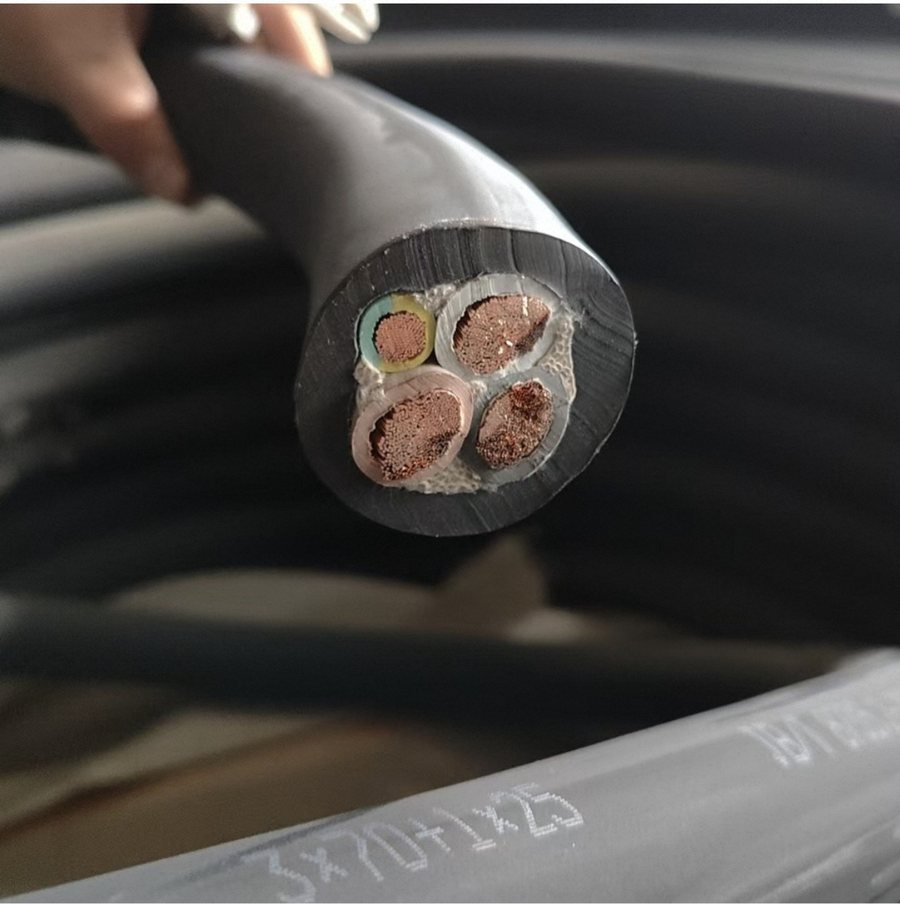
Factory: Changyuan, Henan, China — inside the crane industrial park · Marketing center: Shanghai, China
Products: YC / YZW rubber cable, YVFB flat festoon cable, control, power and special cables
OEM / ODM: from 500 m — your brand, our manufacturing · Standards: IEC 60227 / 60245, GB/T
Every reply: price, lead time and the document list — within 24 working hours
The eight fields that decide whether the cable is right
Most datasheets run to two or three pages. In practice, eight fields carry almost all of the risk. If those eight are correct and consistent, the cable will do its job. If any one of them is vague — or contradicts another field on the same sheet — stop and ask.
| Field | What it really tells you | The trap buyers fall into |
|---|---|---|
| Conductor size and class | How much current it can carry, and how flexible it will be | Reading mm² as a current rating, or ignoring strand class on a cable that has to flex |
| Voltage rating (U0/U) | The insulation thickness and the system it may be installed in | Treating “450/750 V” as a single 450 V limit |
| Insulation and sheath material | Oil, water, heat and abrasion resistance | Assuming two cables with the same model number use the same compound |
| Temperature rating | The continuous operating limit, and the warranty boundary | Ignoring the difference between continuous and short-circuit temperature |
| Standard reference | Which test regime the cable was designed and tested against | Accepting “international standard” with no number and no year |
| Core identification | Whether your electricians can wire it without a mistake | Buying a colour code that does not match the local installation practice |
| Drum length and tolerance | How much cable you actually receive, and how many joints you will make | Comparing prices per drum instead of prices per metre |
| Test report and traceability | Whether you can prove what you bought, six months later | Accepting a report with no batch number linking it to your shipment |
Field 1: conductor — size, strand count and class
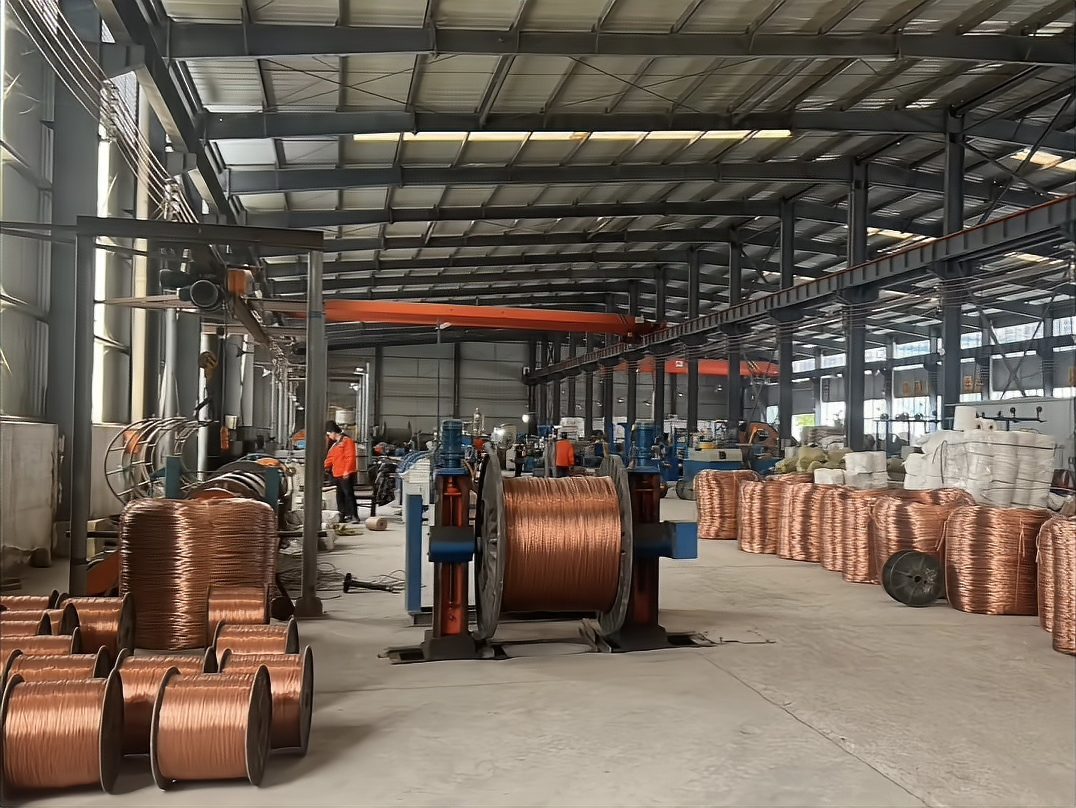
Conductor size is written in square millimetres of cross-sectional area (mm²), not in diameter and not in current. A 2.5 mm² conductor is not “2.5 mm wide”; it is a bundle of copper wires whose combined cross-section equals 2.5 mm². Diameter tells you almost nothing, because the same cross-section can be built from a few thick wires or many thin ones.
That is where strand class comes in. A solid or few-strand conductor (Class 1 or 2) is stiff and suits fixed wiring inside a wall. A finely stranded conductor (Class 5 or 6, often written as 5 or 6 in the model or datasheet) is built for repeated flexing — festoon cables on a crane trolley, trailing cables on moving equipment, anything that bends thousands of times a year. Put a stiff conductor where a flexible one belongs and it will work-harden and break at the terminal. Put a flexible one where a stiff one belongs and you have paid for flexibility you cannot use.
Buyers converting from AWG-based specifications should treat any published conversion table as approximate and confirm the actual mm² on the datasheet. The two systems were designed around different wire sizes, so a “14 AWG equivalent” is a convenience, not an identity.
| Nominal mm² | Approximate AWG | Typical use |
|---|---|---|
| 1.5 | ~16 | Control circuits, small hoists, lighting |
| 2.5 | ~14 | General control and small power circuits |
| 4 | ~12 | Motor feeds, festoon systems |
| 6 | ~10 | Motor feeds, medium current |
| 10 | ~8 | Power distribution on cranes and hoists |
| 16 | ~6 | Main feeds, larger drives |
| 25 | ~4 | Mains, high-current equipment |
| 35 | ~2 | Mains, distribution panels |
Field 2: voltage rating — U0/U is not “450 volts”
A rating written as 450/750 V carries two numbers, and they mean different things. U0 is the voltage between a conductor and earth (or the metallic screen). U is the voltage between two conductors. So 450/750 V describes a cable for a 450 V phase-to-earth / 750 V phase-to-phase system — it is not a cable that must never see more than 450 V.
Why this matters commercially: a cable rated 300/500 V and one rated 450/750 V can look almost identical on the outside. The difference is inside — insulation wall thickness, test voltage, and often the compound itself. If your installation is 400 V three-phase, a 300/500 V cable is the wrong product regardless of how thick the sheath looks, and no amount of oversizing the conductor fixes it.
Field 3: insulation and sheath — read the letters
Cable model letters are a compressed description of material and construction, but each national system uses its own letters. In the Chinese GB/T system, for example, V generally indicates PVC, YJ indicates cross-linked polyethylene, and the rubber-sheathed families are grouped under Y — with YC for heavy duty, YZ for medium duty and YQ for light duty. In IEC-based descriptions you will instead see compounds named directly: PVC, XLPE, EPR, CSP.
Do not translate one system into another by eye. The question to ask your supplier is not “what does YC mean” but “what compound is the insulation, what compound is the sheath, and what does the datasheet say about oil, water and abrasion resistance”. Those three answers tell you whether the cable survives your environment. A cable hanging over a furnace and a cable lying in a wet trench can share a model number and should not share a compound.
Field 4: temperature — the number that voids the warranty
Every datasheet should state a continuous operating temperature. Common figures are around 70 °C for PVC-insulated cable, around 90 °C for XLPE, and lower for many rubber-insulated flexible cables — often 60 °C — with a separate, much higher short-circuit temperature that applies only for a few seconds.
The trap is that the same model number from two factories can be offered at different temperature classes. When that happens, the cheaper drum is usually the lower class. Check the number on the sheet, check it against the ambient temperature and the heat radiated by your equipment, and put it in the purchase order. A cable that runs 15 °C above its rating does not fail immediately; it fails in year two, when the insulation has hardened and cracked and nobody remembers which supplier quoted what.
Field 5: standard reference — check that it is real
“International standard” is not a standard. A usable reference has a body, a number and usually a year: IEC 60245, IEC 60227, GB/T 5013, GB/T 5023, BS 6500, and for many markets a national mark such as Indonesia’s SNI. Each one defines the tests the cable must pass — insulation resistance, voltage withstand, tensile strength and elongation before and after ageing, and for rubber cables the mechanical tests after oil or ozone exposure.
Ask for the reference in writing, then ask the second question that separates factories from traders: can you send the batch test report for this drum, with a batch number that matches the marking on the cable? A factory that has run the tests can answer in a day. A reseller usually cannot answer at all.
Field 6: core identification and colour code
This field looks trivial until an electrician wires a panel from memory. Cores are identified by colour, by number, or by both, and the convention differs between regions and between customers. If the drawing in your office uses one convention and the drum uses another, the cable is not defective — it is simply unusable without re-marking, which costs you the install day.
For anything above a handful of cores, put the colour code in the purchase order as a drawing or a written list, and ask for a short length of the actual cable to be photographed before the run is completed. Two minutes of confirmation beats a rejected shipment.
Field 7: drum length and tolerance
Drum length is where quotations become hard to compare. One supplier quotes per drum at 100 m, another at 95 m with a stated tolerance, a third quotes per metre and then bills a full drum. When you compare, convert everything to price per metre delivered, and ask what happens if the drum comes up short.
Length also drives joints. A cable run that needs a joint because the drum was 5 m short introduces a failure point that did not exist in the design. For long festoon or trailing systems, state the required continuous length and the acceptable tolerance in the order.
Field 8: test report and traceability
The last field is the one buyers skip and later regret. A test report is only useful if it can be tied to your shipment — batch number on the report, batch number on the cable marking, batch number on the packing list. Without that chain, a report proves that the factory can make good cable, not that it made yours.
Ask for the report with the shipment, not after the problem. And ask what documents the supplier can provide in whose name they are issued: factory test report, third-party test report, declaration of conformity, certificate of origin. A serious supplier will list these before you ask, because they know which ones they can and cannot stand behind.
What a datasheet will not tell you
Three things never appear on a specification sheet, and they matter as much as the eight fields above.
How the cable behaves after two years. Ageing resistance is a test, not a sentence. Ask for ageing data, or ask for references from customers running the same model in a similar environment.
Whether the factory can repeat it. A sample can be perfect and a production run average. Ask what changes between sample and mass production, and ask for the inspection record of the actual batch.
What happens when something goes wrong. The datasheet says nothing about who answers the phone at that point. That is a question about the supplier, not the product — and it is worth asking before the order rather than after.
A five-minute check before you approve
Before you sign off a datasheet, read it once for consistency rather than for detail. Conductor size should match the current the application needs. Voltage class should match the installation. Temperature rating should clear the ambient plus the heat from the equipment. Standard reference should name a body and a number. Drum length should be stated with a tolerance. The colour code should match your drawing. If all seven agree with each other and with your job, the eighth — the test report — is the only thing left to chase.
If any line is blank, vague, or contradicts another line on the same sheet, that is the question to send back. It takes one email, and it is much cheaper than a rejected container.
Frequently asked questions
What is the difference between U0 and U in a cable rating?
U0 is the voltage between a conductor and earth; U is the voltage between two conductors. A 450/750 V cable is designed for a system with 450 V phase-to-earth and 750 V phase-to-phase — it is not limited to 450 V overall.
Does a higher voltage rating always mean a better cable?
No. A higher rating means thicker insulation and a more demanding test regime, which is right for a higher-voltage system and wasteful for a low-voltage one. Match the rating to the installation, then judge quality by the compound, the test report and the factory’s consistency.
Can I use a 300/500 V cable on a 400 V three-phase system?
No. A 400 V three-phase system needs a cable rated for that system voltage — 450/750 V in most crane and hoist applications. Conductor size does not compensate for an inadequate voltage class.
Why do two suppliers quote the same model at different prices?
Usually because one of the fields on this page differs: conductor strand class, insulation compound, temperature class, drum length or the test regime behind the standard reference. Ask both suppliers to fill in the same eight fields and the price difference usually explains itself.